Designing Effective Learning Experiences
A comprehensive synthesis of 8 evidence-based principles for designing effective and inclusive learning experiences, covering curriculum design, assessment strategies, and learner support.
Role
Skills & Tools
Best Time Manager Team
Work Responsibilities
A comprehensive synthesis of 8 evidence-based principles for designing effective and inclusive learning experiences, covering curriculum design, assessment strategies, and learner support.
Overview
In this synthesis, we explore foundational principles for designing effective and inclusive learning experiences. To deepen our inquiry and provide clarity, we framed each Big Idea as a guiding question. This approach encourages reflective engagement and highlights actionable strategies for improving student outcomes.
By asking "How can we...?" across critical educational challenges, we invite exploration of alignment between learning goals, assessments, and instructional activities, the role of inclusivity, and techniques for enhancing engagement, mastery, and knowledge transfer. These questions serve as the foundation for cohesive curriculum design and inspire innovative applications in diverse learning contexts.

Big Ideas-Driven Five-Phase Education Design
This framework shows how the 8 Big Ideas integrate across the five phases of instructional design: Understanding learner in context, Targeting explicit goals, Implicating assessment towards goals, Designing instruction to reach goals, and Conducting evaluation research to provide evidence.
| Understanding learner in context | Targeting explicit goals | Implicating assessment towards goals | Designing instruction to reach goals | Conducting evaluation research to provide evidence |
|---|---|---|---|---|
| 1 How Can We Enhance Inclusivity for Students from Diverse Backgrounds in Curriculum Design? | 2 How Can We Design to Ensure Alignment of Goals, Assessments, and Instruction? | 2 How Can We Design to Ensure Alignment of Goals, Assessments, and Instruction? | 2 How Can We Design to Ensure Alignment of Goals, Assessments, and Instruction? | 7 How Can We Facilitate the Transfer of Knowledge and Skills in Learning Experiences? |
| 3 How Can We Design Study Environments and Structures to Enhance Learning Outcomes? | 7 How Can We Facilitate the Transfer of Knowledge and Skills in Learning Experiences? | 4 How Can We Design Effective Assessments to Improve Learning and Teaching? | 5 How Can We Use Worked Examples to Break Down Complex Problems? | 2 How Can We Design to Ensure Alignment of Goals, Assessments, and Instruction? |
| 8 How Can We Foster Self-Regulated Learning in Students? | 8 How Can We Foster Self-Regulated Learning in Students? | 6 How Can We Accelerate Learning Through Targeted Practice and Timely Feedback? | 8 How Can We Foster Self-Regulated Learning in Students? |
Key Themes and Their Connection to 8 Big Ideas
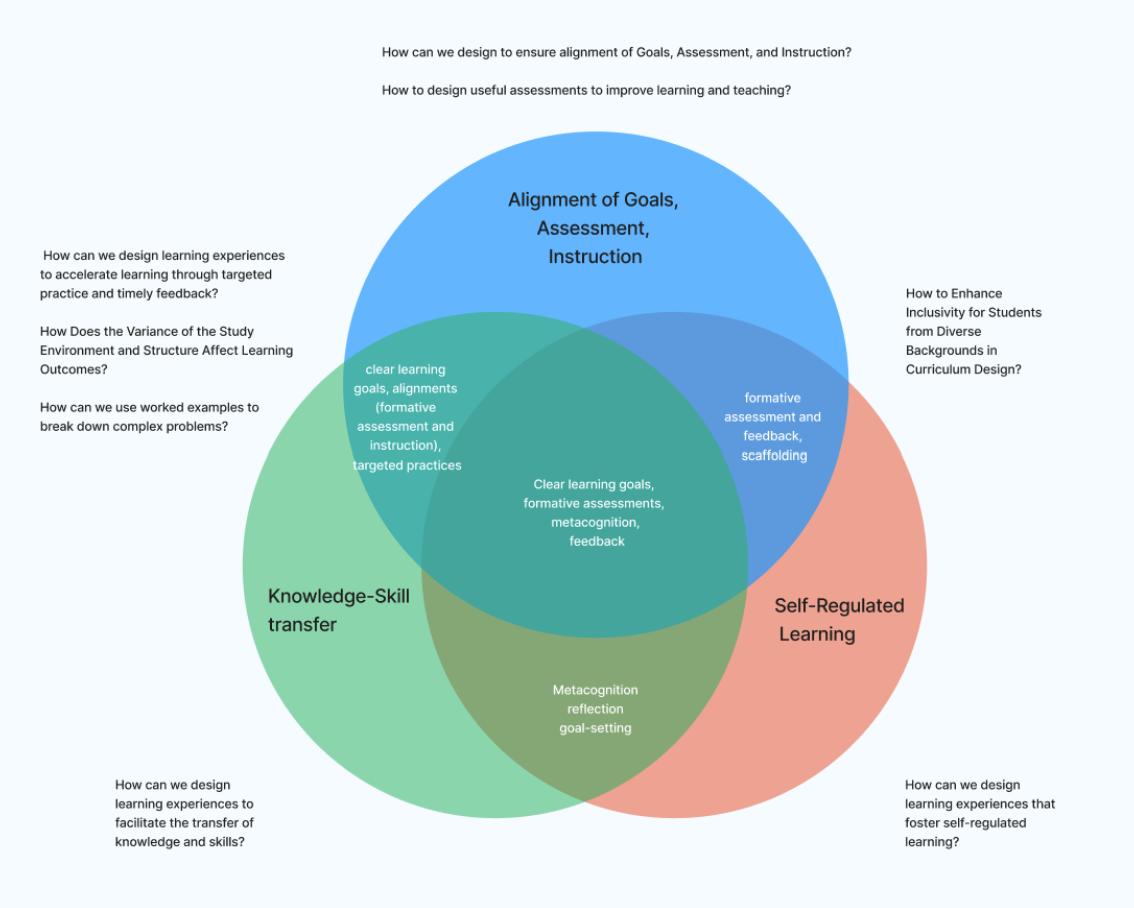
These six interconnected themes represent the core ideas that emerge across all eight Big Ideas, demonstrating why they matter, key strategies, and their connections to specific Big Ideas.
| Key Theme | Why It Matters | Strategies | Connection to Big Ideas |
|---|---|---|---|
| T1: Feedback | Reinforces learning, corrects misconceptions, and supports engagement. | Timely and frequent feedback, Process-oriented, not just outcomes, Personalized to learner needs | Big Idea 4, 6, 7 |
| T2: Personalization | Enhances engagement, inclusivity, and learning outcomes by addressing diversity. | Culturally relevant materials, Flexible learning paths, Learner choice | Big Idea 1, 3, 8 |
| T3: Scaffolding | Reduces cognitive load, fosters independence, and aids in understanding complex tasks. | Step-by-step guidance, Gradual release of responsibility, Support within ZPD | Big Idea 2, 5, 6 |
| T4: Metacognition | Encourages self-regulated learning, improves problem-solving, and supports lifelong learning. | Reflection exercises; Think-aloud protocols; Self-assessment tools | Big Idea 7, 8 |
| T5: Knowledge Transfer | Ensures learners can apply skills flexibly and adapt to varied situations. | Contextual variation; Principle-based learning; Interleaved practice | Big Idea 3, 6, 7 |
| T6: Backward Design | Aligns goals, assessments, and instruction to ensure coherence. | Start with learning outcomes; Design assessments to measure outcomes; Build activities to support goals | Big Idea 2, 4 |
8 Big Ideas
Each Big Idea encompasses multiple learning theories and evidence-based principles, providing a comprehensive framework for instructional design.
Design Regulations
Practical guidelines synthesized from the 8 learning principles to guide effective instructional design.
Do This
- ✓Design with learner diversity in mind from the start
- ✓Align all learning components systematically
- ✓Provide varied, timely feedback to guide learning
- ✓Create psychologically safe learning environments
- ✓Use multiple assessment formats to capture learning
- ✓Model expert thinking and problem-solving explicitly
- ✓Design practice that promotes transfer across contexts
- ✓Teach metacognitive strategies explicitly
- ✓Foster growth mindset and learner autonomy
- ✓Connect learning to real-world and cultural contexts
Avoid This
- ✗Assume one-size-fits-all approaches work for all learners
- ✗Create misalignment between goals, instruction, and assessment
- ✗Provide feedback too late or too vague to be actionable
- ✗Ignore the importance of belongingness and psychological safety
- ✗Rely on single assessment types or formats
- ✗Skip worked examples and jump straight to problem-solving
- ✗Practice only in narrow contexts without variation
- ✗Leave learning strategies implicit and unexamined
- ✗Focus only on performance without developing self-regulation
- ✗Ignore cultural responsiveness and inclusive design
Impact & Applications
This synthesis serves as a practical guide for educators and instructional designers, translating complex learning science research into actionable design principles. It has been used to inform curriculum development and assessment design in educational technology projects, helping create more effective and inclusive learning experiences.